
AI SEO vs Traditional SEO: What Is the Difference?
For twenty years, ranking on Google’s first page was the whole game. Today, a growing share of your customers never make it to a results page at all — they ask ChatGPT, Gemini, Perplexity, or Google’s AI Overviews a question, and get a direct answer with no click required. That shift is why “AI SEO vs traditional SEO” has become one of the most searched questions among marketers and website owners in 2026.
In this article, we’ll break down exactly how AI SEO differs from traditional SEO, why both still matter, and how to make sure your WordPress site is optimized for each.
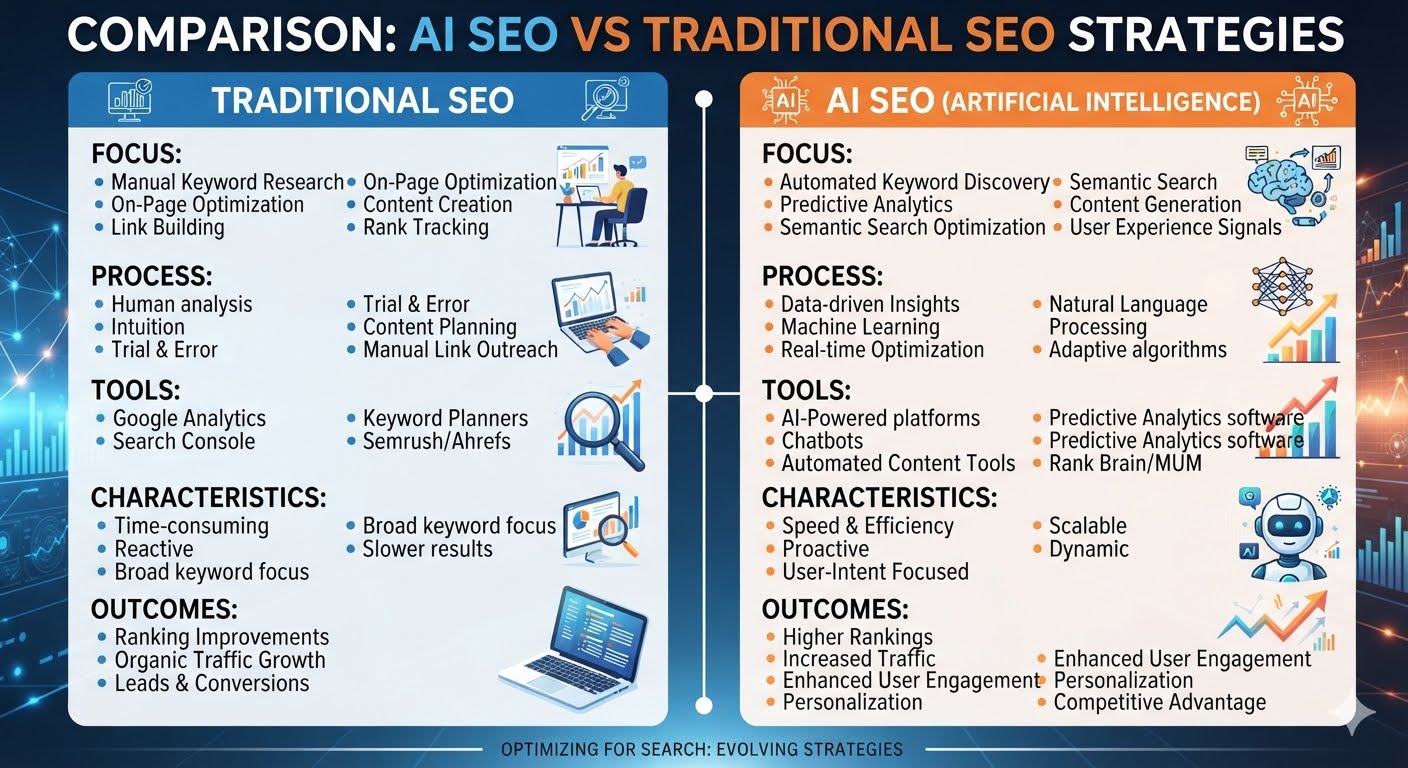
What Is Traditional SEO?
Traditional SEO (Search Engine Optimization) is the practice of optimizing a website so it ranks higher in classic search engine results pages (SERPs) — primarily Google and Bing. The goal is simple: earn a top position for a target keyword so users click through to your site.
Traditional SEO typically focuses on:
- Keyword optimization — targeting specific search terms in titles, headers, and body content
- Backlinks — earning links from other websites to build domain authority
- On-page factors — meta titles, meta descriptions, header structure, and internal linking
- Technical SEO — site speed, mobile-friendliness, crawlability, and XML sitemaps
- Click-through rate — success is measured by how many users click your listing and visit your site
This approach has worked well for decades because search engines returned a list of links, and users chose where to click.
What Is AI SEO?
AI SEO — sometimes called AEO (Answer Engine Optimization) or GEO (Generative Engine Optimization) — is the practice of optimizing content so that AI assistants and generative search tools cite, quote, or reference your site directly inside their answers.
Instead of returning a list of links, tools like ChatGPT, Claude, Gemini, and Perplexity generate a single conversational answer — often without sending the user to any website at all. If your content is chosen as a source, the AI may credit you by name or link. If it isn’t structured the way these models expect, you’re simply left out of the answer entirely.
AI SEO focuses on:
- Structured, quotable content — clear, direct answers to specific questions, not just narrative text
- Schema markup — structured data that helps AI models understand entities, relationships, and facts on your page
- FAQ formatting — content organized in the exact question-and-answer shape AI systems pull from
- Entity clarity — making it unambiguous who, what, and where your content is about
- Citation-worthiness — success is measured by whether the AI mentions or links to you, not by a ranking position
AI SEO vs Traditional SEO: Key Differences
| Factor | Traditional SEO | AI SEO |
|---|---|---|
| Goal | Rank #1 on the results page | Get cited inside the AI-generated answer |
| Success metric | Click-through rate, ranking position | Mentions, citations, referral traffic from AI tools |
| Content style | Keyword-optimized, narrative | Direct, structured, question-and-answer |
| Schema markup | Optional, generic | Essential and detailed (Article, FAQ, Product, HowTo) |
| Platforms | Google, Bing search results | ChatGPT, Claude, Gemini, Perplexity, AI Overviews, Copilot |
| Backlinks | Primary authority signal | Helpful, but entity clarity and structure matter more |
Why You Still Need Both
AI SEO isn’t a replacement for traditional SEO — it’s an additional layer on top of it. Google still sends the majority of organic traffic to most websites, and traditional ranking factors (site speed, mobile usability, backlinks, keyword relevance) remain foundational. At the same time, AI answer engines are already influencing a meaningful share of buying decisions and research, and that share is growing every quarter.
The websites that win in 2026 and beyond will be the ones that treat AI visibility and traditional SEO as two sides of the same strategy, rather than competing priorities.
How to Optimize Your WordPress Site for Both
If you run a WordPress site, here’s a practical path to covering both traditional and AI SEO without hiring a full technical team:
1. Audit your AI visibility, not just your rankings
Most SEO plugins only check classic ranking factors. To see how AI platforms actually read your content, you need a tool built specifically for that. Rudwexa AI Visibility scans your WordPress site, scores it separately across ChatGPT, Claude, Gemini, Perplexity, Google AI Overviews, and Copilot, and shows you exactly what’s missing — schema, FAQ structure, thin content, or unclear entities.
2. Fix structural issues in one click
Once you know what’s missing, the same plugin can generate Article, FAQ, and Organization schema, write meta descriptions, add alt text, and expand thin pages — all from inside your WordPress dashboard. This closes the gap between “found an issue” and “fixed an issue” without needing a developer.
3. Keep the technical foundation healthy
Neither traditional SEO nor AI SEO works on a broken site. Crawl errors, plugin conflicts, security gaps, and broken links quietly undermine both. Rudwexa AutoFixer scans your site across 13 categories — PHP errors, deprecated functions, security exposure, orphaned database rows — and safely applies fixes automatically, with a snapshot and one-click rollback on every change.
4. Automate the workflows behind your content
SEO and AI visibility aren’t one-time projects — they depend on consistent publishing, follow-up, and internal processes. If your team is still manually managing lead follow-ups, content approvals, or customer support routing, it’s worth looking at AI Workflow Automation to free up the time your team needs to focus on content and strategy instead of repetitive admin work.
Frequently Asked Questions
Is AI SEO replacing traditional SEO?
No. AI SEO adds a new layer of optimization on top of traditional SEO. Google search still drives significant traffic, so both need attention.
Do I need a different plugin for AI SEO than for traditional SEO?
Traditional SEO plugins check keywords, meta tags, and sitemaps, but most don’t evaluate schema depth, FAQ structure, or how AI models parse your content. A dedicated AI visibility tool covers what traditional plugins miss.
How do I know if AI assistants are citing my website?
Tools built for AI SEO can track the actual prompts people ask AI assistants in your niche and show whether your site gets mentioned in the response.
Final Thoughts
The difference between AI SEO and traditional SEO comes down to where your audience is asking questions and how they expect an answer. Traditional SEO earns you a spot on the results page. AI SEO earns you a mention inside the answer itself. Doing both well is quickly becoming the baseline for any WordPress site that wants to stay visible in 2026 and beyond.