
Search behavior is changing fast. Millions of people now ask ChatGPT, Perplexity, Google AI Overviews, and other AI tools for answers instead of typing a query into a traditional search box and scrolling through ten blue links. If your WordPress website isn’t structured for AI search optimization, you’re invisible to a growing share of your audience — no matter how well you rank on Google.
This guide walks you through exactly how to optimize your WordPress site for ChatGPT SEO, AI Overviews, and generative search engines, using proven on-site techniques and the right WordPress plugins.
What Is AI Search Optimization (AEO/GEO)?
AI Search Optimization — also called Answer Engine Optimization (AEO) or Generative Engine Optimization (GEO) — is the practice of structuring your content so AI models like ChatGPT, Google Gemini, and Perplexity can easily read, understand, and cite it as a source.
Traditional SEO focuses on ranking in search results. AEO focuses on becoming the answer — the content an AI model pulls from and references when generating a response. Both matter, but AI search optimization has its own rules.
Why WordPress Sites Need AI Search Optimization Now
- AI chatbots increasingly pull real-time and indexed content from the web to answer questions.
- Google’s AI Overviews already appear on a large share of search results, pushing traditional organic listings further down the page.
- Sites with clear structure, fast performance, and clean technical SEO are far more likely to be cited by AI tools.
- Early movers in AI visibility optimization are gaining a competitive advantage before this becomes standard practice.
If you run a WordPress blog, business site, or e-commerce store, here’s how to make sure your content is AI-search-ready.
1. Structure Content for Direct Answers
AI models favor content that answers a question clearly and quickly, rather than burying the answer under long, vague intros.
- Open each key section with a direct, concise answer (2–3 sentences).
- Use clear, question-based H2 and H3 headings (“How does X work?”, “What is the best way to Y?”).
- Follow the direct answer with supporting detail, examples, or data.
- Use bullet points and numbered lists for scannable, extractable information.
This format mirrors how ChatGPT and AI Overviews summarize content — making it easier for them to lift your answer accurately.
2. Nail Your Technical SEO Foundation
AI crawlers and traditional search bots both need clean, crawlable WordPress sites. Focus on:
- Fast page speed — Compress images, use caching, and choose lightweight themes.
- Mobile responsiveness — Most AI-driven traffic originates from mobile search behavior.
- Clean URL structure — Short, descriptive, keyword-relevant permalinks.
- XML sitemaps — Submitted to Google Search Console and Bing Webmaster Tools.
- HTTPS and valid SSL — A baseline trust signal for both crawlers and AI systems.
Technical SEO issues (broken links, missing alt text, duplicate meta tags, slow load times) are exactly the kind of problems that quietly tank your AI visibility — and they’re tedious to catch manually across hundreds of pages.
This is where the Rudwexa AutoFixer WordPress Plugin becomes valuable. It automatically scans your WordPress site for technical SEO issues — broken links, missing meta descriptions, image alt text gaps, and more — and fixes them without manual intervention, keeping your site in the clean, crawlable shape that AI search engines reward.
3. Use Structured Data (Schema Markup)
Schema markup is one of the strongest signals you can give AI models and search engines about what your content actually means.
Implement schema for:
- Article and BlogPosting for blog content
- FAQPage for question-and-answer sections
- HowTo for step-by-step guides
- Organization and LocalBusiness for brand and location details
- Product and Review schema for e-commerce pages
Structured data helps AI tools pull accurate facts (author, publish date, ratings, steps) directly, increasing the odds your content gets cited instead of a competitor’s.
4. Write for E-E-A-T: Experience, Expertise, Authority, Trust
AI models are trained to favor content that demonstrates real expertise and trustworthiness — the same E-E-A-T signals Google has emphasized for years.
- Include author bios with real credentials on blog posts.
- Cite original data, research, or first-hand experience where possible.
- Link out to authoritative, relevant sources.
- Keep content updated — stale, outdated posts lose both rankings and AI citations.
5. Optimize for Featured Snippets and AI Overviews
Featured snippets and AI-generated summaries pull from remarkably similar content patterns:
- Answer the core question in the first 40–60 words of a section.
- Use tables for comparison-based content (pricing, specs, pros/cons).
- Add a concise FAQ section at the end of long-form posts, using real questions your audience searches for.
- Keep paragraphs short — 2–4 sentences — for easy extraction.
6. Monitor and Improve Your AI Search Visibility
Traditional analytics tools don’t show you whether ChatGPT, Perplexity, or Google AI Overviews are actually surfacing your content. Without visibility into this, you’re optimizing blind.
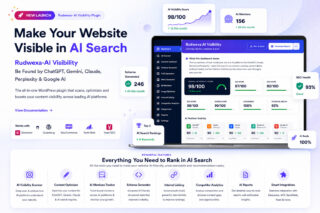
The Rudwexa AI Visibility WordPress Plugin solves this by tracking how your WordPress content performs across AI search engines and chatbots. It helps you identify which pages are being picked up by AI tools, spot content gaps, and understand where to focus your optimization efforts — giving you the same level of insight for AI search that Google Search Console gives you for traditional search.
Used together, Rudwexa AI Visibility and Rudwexa AutoFixer form a practical workflow: AutoFixer keeps your technical SEO clean, while AI Visibility shows you how that clean, well-structured content is actually performing in AI-driven search.
7. Build Topical Authority with Internal Linking
AI models — like traditional search engines — use internal linking patterns to understand which topics your site is authoritative on.
- Link related blog posts and pages together naturally within your content.
- Use descriptive, keyword-rich anchor text (avoid generic “click here” links).
- Build pillar pages that link out to detailed subtopic articles, and link back.
- Keep your site architecture shallow — important pages should be reachable within 2–3 clicks from the homepage.
8. Keep Content Fresh and Comprehensive
AI systems tend to favor recently updated, comprehensive resources over thin or outdated pages. Periodically:
- Update statistics, examples, and screenshots.
- Expand thin posts with more depth and better structure.
- Merge or redirect duplicate/overlapping content to consolidate authority.
Frequently Asked Questions
Does ChatGPT crawl WordPress websites directly? ChatGPT and similar AI tools often rely on web crawls, search plugins, or indexed data (including from Bing and other sources) to retrieve information. Making your site technically clean and well-structured increases the chance your content is included in that data.
Is AI search optimization different from regular SEO? They overlap heavily. Good technical SEO, schema markup, and clear content structure benefit both traditional rankings and AI citations. AEO simply adds an extra layer of emphasis on direct, extractable answers and structured data.
What’s the fastest way to improve AI visibility on WordPress? Start by fixing technical SEO issues with a tool like Rudwexa AutoFixer, then track your AI search performance with Rudwexa AI Visibility to see what’s working and where to improve next.
Final Thoughts
Optimizing your WordPress site for ChatGPT and AI search isn’t a one-time project — it’s an ongoing process built on clean technical SEO, clear content structure, structured data, and continuous monitoring. By combining strong on-page practices with tools like

and
you can keep your WordPress site fast, technically sound, and positioned to be found — and cited — by the AI tools shaping the future of search.