
For the better part of two decades, ranking on the first page of Google was the gold standard of digital visibility. But the way people find information is changing fast. Instead of typing a query into a search bar and scrolling through ten blue links, more and more users are asking AI tools like ChatGPT, Perplexity, Google’s AI Overviews, and Claude for direct answers.
This shift has given rise to a new discipline: Generative Engine Optimization (GEO).
If you’ve never heard the term before, you’re not alone — it’s a relatively new concept that’s still being defined by marketers, SEOs, and content strategists in real time. This guide breaks down exactly what Generative Engine Optimization is, how it differs from traditional SEO, why it matters, and how you can start optimizing your content for AI-driven search today.
What Is Generative Engine Optimization (GEO)?
Generative Engine Optimization (GEO) is the practice of optimizing content so that it gets discovered, understood, and cited by generative AI systems — tools that produce conversational, synthesized answers rather than a simple list of links.
Where traditional SEO focuses on ranking a webpage in a search engine results page (SERP), GEO focuses on getting your brand, product, or content referenced, quoted, or recommended inside an AI-generated response. Think of GEO as the answer to a simple question: “How do I make sure AI models mention my content when someone asks a relevant question?”
This includes optimizing for:
- AI-powered search engines (Google AI Overviews, Bing Copilot)
- AI chatbots (ChatGPT, Claude, Gemini)
- Answer engines (Perplexity, You.com)
- AI shopping and recommendation assistants
Why Generative Engine Optimization Matters Now
A few years ago, “optimizing for AI” would have sounded like a futuristic buzz-phrase. Today, it’s a practical necessity for anyone who depends on organic visibility to drive traffic, leads, or sales.
Here’s why GEO has become impossible to ignore:
1. AI answers are replacing clicks. When a generative engine gives users a complete answer directly on the results page, many users never click through to a website at all. This phenomenon — often referred to as “zero-click search” — means visibility inside the AI’s answer matters more than ever, because for many searches, that answer is the search result.
2. Search behavior is shifting toward conversational queries. People are asking AI tools longer, more natural-language questions than they typically type into Google. Content written for GEO needs to anticipate and answer these more conversational, intent-rich queries.
3. AI Overviews are already reshaping SERPs. Google has rolled AI-generated summaries into search results for a large share of queries. If your content isn’t structured in a way AI can easily parse and trust, you risk losing visibility even if you rank well organically.
4. Being cited by AI builds authority and trust. When an AI model references your brand as a source, it can function similarly to a trusted recommendation — often carrying more perceived credibility than a standard search listing.
GEO vs. SEO: What’s the Difference?
GEO and SEO share the same end goal — visibility — but they approach it differently.
| Factor | Traditional SEO | Generative Engine Optimization (GEO) |
|---|---|---|
| Goal | Rank high in search engine results pages | Get cited or referenced in AI-generated answers |
| Primary audience | Search engine crawlers and human readers | Large language models (LLMs) and AI answer engines |
| Key metrics | Rankings, click-through rate, organic traffic | Citation frequency, share of AI voice, brand mentions |
| Content format | Keyword-optimized pages, backlinks, meta tags | Clear, structured, fact-dense, well-sourced content |
| User intent focus | Search queries | Conversational, natural-language questions |
| Technical levers | Site speed, schema markup, backlinks | Structured data, authoritativeness, clarity, citations |
Importantly, GEO doesn’t replace SEO — it builds on it. Strong technical SEO fundamentals (site structure, crawlability, authority) still matter because generative engines often rely on the same indexed web content that traditional search engines use to train and ground their answers.
How Generative Engines Choose What to Cite
To optimize for generative engines, it helps to understand how they actually select and synthesize information. While each AI system works differently, most share a few common patterns:
- They pull from crawled and indexed web content — much like traditional search engines, generative AI tools rely on large-scale web data to inform their answers.
- They favor clear, well-structured information — content that’s easy to parse (like lists, tables, and direct answers) is easier for an AI model to extract and summarize accurately.
- They weigh authority and trust signals — sources with strong topical authority, backlinks, and consistent citations elsewhere on the web are more likely to be trusted and referenced.
- They prioritize freshness and accuracy — up-to-date, fact-checked content is more likely to be pulled into a generated answer than outdated or vague material.
- They reward direct, quotable answers — content that clearly and concisely answers a specific question is easier for an AI to lift and cite than content buried in fluff.
Core Principles of Generative Engine Optimization
If you want your content to show up in AI-generated answers, here are the foundational strategies to focus on.
1. Answer Questions Directly and Clearly
Generative engines favor content that gets to the point. Structure your content so that key questions are answered in the first sentence or two of a section, then expand with supporting detail. Avoid burying the answer under long introductions.
2. Use Clear Structure and Formatting
Headers, bullet points, numbered lists, and tables aren’t just good for readability — they make it easier for AI models to extract discrete facts. Break complex topics into digestible chunks rather than dense paragraphs.
3. Build Topical Authority
Generative engines are more likely to cite sources that demonstrate deep expertise on a subject. Publishing comprehensive, interlinked content around a topic — rather than a single isolated post — signals authority and increases the odds of being referenced.
4. Back Up Claims with Data and Sources
Original research, statistics, case studies, and expert quotes make content more citation-worthy. AI models tend to favor content that reads as credible and well-supported rather than opinion-only.
5. Optimize for Natural Language and Long-Tail Queries
Since people phrase questions to AI tools conversationally, your content should mirror that language. Instead of only targeting short keywords, address the full, natural questions your audience is likely to ask.
6. Use Structured Data (Schema Markup)
Structured data helps machines understand the context of your content — such as FAQs, how-to steps, product details, or reviews — making it easier for generative engines to parse and reuse.
7. Maintain Consistency Across the Web
Generative engines often cross-reference multiple sources to validate information. Make sure your brand’s facts, statistics, and positioning are consistent across your website, social profiles, directories, and third-party mentions.
8. Keep Content Fresh
Outdated statistics or old information can hurt your chances of being cited. Regularly updating high-value pages signals to both search engines and AI crawlers that your content remains relevant.
How to Measure GEO Success
GEO is still an emerging field, and measurement tools are evolving quickly, but a few practical ways to track performance include:
- Manual prompt testing — regularly ask relevant questions in tools like ChatGPT, Perplexity, and Google AI Overviews to see if and how your brand is mentioned.
- Brand mention tracking — monitor how often your brand or content appears as a cited source in AI-generated responses.
- Referral traffic from AI platforms — check your analytics for traffic originating from AI tools and answer engines.
- Share of voice comparisons — compare how often you’re cited relative to competitors for the same set of queries.
Common GEO Mistakes to Avoid
- Treating GEO as a replacement for SEO — the two work together, not against each other.
- Keyword stuffing — generative engines prioritize clarity and usefulness over keyword density.
- Writing vague, generic content — AI models favor specific, well-supported answers over broad generalizations.
- Ignoring structure — content without headers, lists, or clear formatting is harder for AI to parse and extract.
- Neglecting E-E-A-T signals — experience, expertise, authoritativeness, and trustworthiness remain critical, even in an AI-driven search landscape.
The Future of Generative Engine Optimization
As generative AI tools become more embedded in how people search, shop, and make decisions, GEO is likely to become as standard a practice as SEO is today. Brands that adapt early — by producing clear, authoritative, well-structured content — will have a head start in earning visibility inside the AI-generated answers that are increasingly shaping consumer decisions.
The core idea behind GEO isn’t fundamentally different from good content marketing: create genuinely useful, trustworthy, well-organized information. What’s changed is who — or rather, what — is reading it first.
Final Thoughts
Generative Engine Optimization represents the next evolution of search visibility. While traditional SEO isn’t going away, ignoring how generative AI tools discover and cite content means leaving a growing share of your potential audience untapped. By focusing on clarity, structure, authority, and up-to-date, well-sourced content, you can position your brand to be the answer AI tools choose to give.
Generative Engine Optimization isn’t a one-time project — it’s an ongoing process built on clean technical SEO, clear content structure, structured data, and continuous monitoring. By combining strong on-page practices with tools like

and
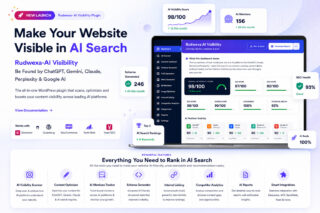
you can keep your WordPress site fast, technically sound, and positioned to be found — and cited — by the AI tools shaping the future of search.